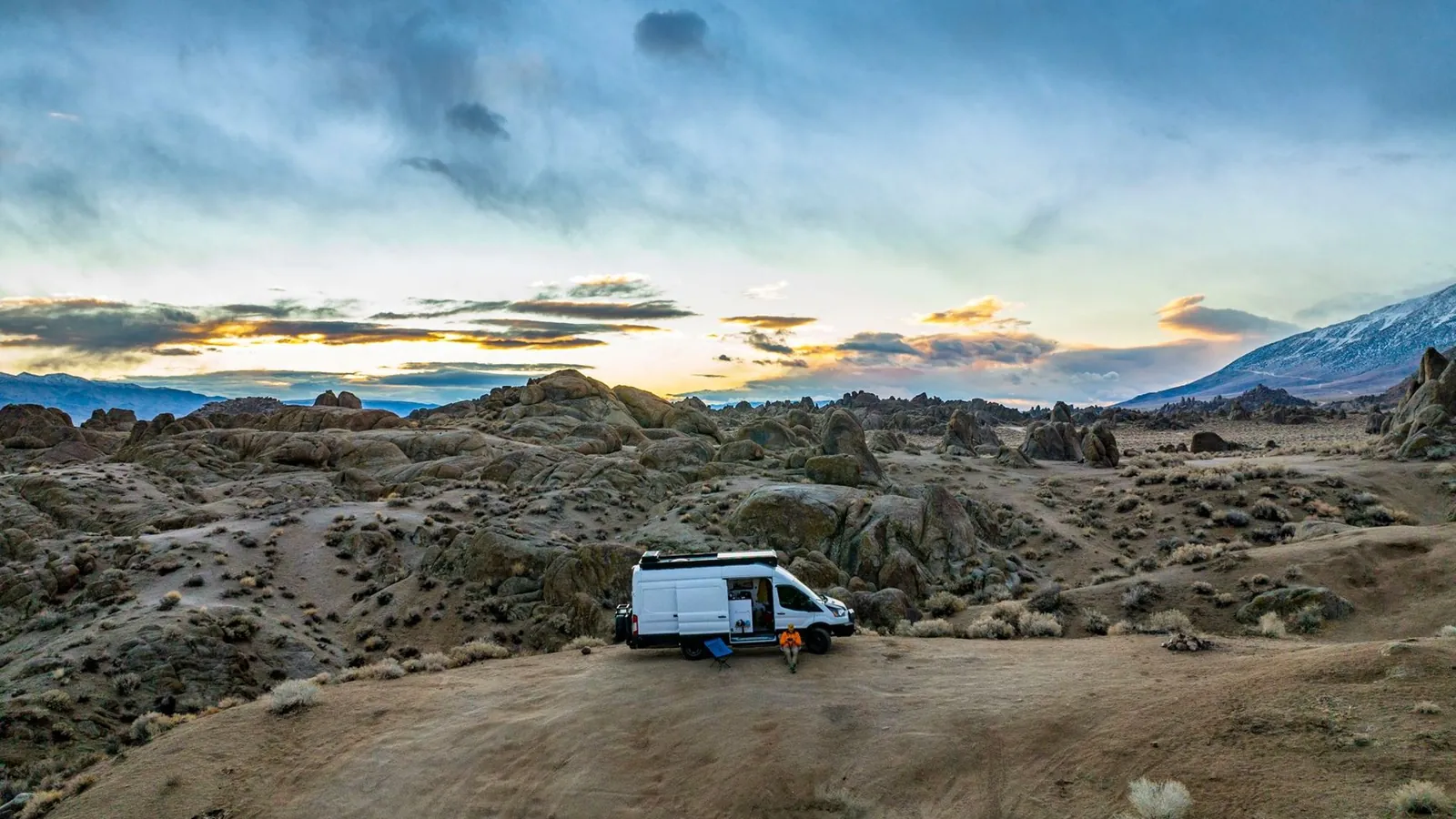
Free overnight parking in the US comes from five places: state rest areas, private lots where the owner says yes, Bureau of Land Management (BLM) land, National Forests and some Army Corps of Engineers lakes. City streets are a sixth option, but only where local rules allow it. None of them is free everywhere. Rest areas follow state law. Private lots follow the manager. Public lands follow stay limits that change from office to office.
The quickest way to choose: if you only need sleep between two driving days, a rest area or a lot where you have permission is usually closest to the highway. If you want to stay put for more than one night, dispersed camping on BLM or National Forest land is the free option made for that. The rules for each are below, with the official sources linked.
Free overnight parking options compared
| Option | Typical cost | Typical stay limit | Facilities | What to verify first |
|---|---|---|---|---|
| State rest area | Free | Set by state law: from 2 hours to 24 hours, and some states ban overnight parking | Restrooms at most; no hookups | The state rule and the sign at the entrance |
| Truck stop or retail lot | Free when the owner allows it | Whatever the manager allows | Varies by business | Permission from the manager on duty, store signs, city ordinance |
| BLM dispersed camping | No fee | Generally 14 days in any 28-day period | None | Field office rules, closures, fire restrictions |
| National Forest dispersed camping | Generally no fee outside developed campgrounds | Set by each forest, often 14 days | None, though some popular areas have toilets | The forest’s stay-limit order and Motor Vehicle Use Map |
| Army Corps of Engineers lake | Fees possible at developed campgrounds; some lakes have primitive areas | 14 days in any 30-day period per project | From none to full campgrounds | Whether the site is designated for camping and whether it charges a fee |
| City street | Free where legal | Set by local ordinance | None | Municipal code and posted parking signs |
Rest areas: free, but limited by state law
A public rest area costs nothing, but each state decides how long you may stay. For 24 states with an official rest area time rule, the limits fall into four groups (the can you sleep at a rest area guide covers all 50 states):
- Long enough for a full night (8 hours or more for cars): California, Idaho (interstate rest areas), Kansas, Montana, Nevada (18 hours in total per two weeks), New Mexico, Oregon, Texas, Utah (no hour limit, but no camping), Washington and Wisconsin.
- Short stays only (2 to 4 hours for cars): Florida, Illinois, Kentucky, Minnesota, Pennsylvania and South Dakota. Florida, Minnesota and South Dakota give commercial drivers on federal hours-of-service rules up to 10 hours.
- No overnight parking: Maryland, Tennessee and Virginia.
- Other rules: Alaska and Massachusetts use the limit posted at each site. New York allows trucks 10 hours and otherwise follows posted signs. Ohio limits leaving a vehicle unattended to 3 hours.
Texas, for example, allows visitors to stay up to 24 hours, while Pennsylvania limits stays to 2 hours in a 24-hour period. Even where a long stay is legal, camping usually is not: California’s rule bans camping at roadside rest areas, and Montana prohibits camping while allowing 12 hours of parking. In practice that means sleeping in your vehicle, not setting up tents, chairs or grills.
The remaining states in our directory have no official rule we could verify, so the posted sign is the rule there. The full state-by-state list is in our time-limit table, and the guide on whether you can sleep at a rest area explains the difference between resting and camping. To find a stop on your route, use the rest area finder or browse rest areas by state.
Toll-road service plazas are a separate case. Several states note that turnpike plazas have their own rules, apart from state rest area law. See toll road service plazas before planning a night at one.
Truck stops and retail parking lots: always ask first
A private parking lot is free only when the owner allows overnight parking. Policies are set by each business and can differ from one location to the next. A city ordinance can also ban overnight parking on a lot even when the business would allow it.
Practical steps that keep you on the right side of both:
- Ask the manager on duty before you settle in, and accept a no without arguing.
- Read the lot signs. “No overnight parking” or “No RVs” signs settle the question.
- Check the city’s rules if you are unsure. Some towns restrict overnight parking or sleeping in vehicles.
- Park, don’t camp. Keep slide-outs, awnings, chairs and generators out of the picture unless you were told otherwise.
- Leave truck spaces to truck drivers. An FHWA truck parking survey under Jason’s Law found that shortages are worst at night and along major corridors, and 90% of surveyed drivers reported struggling to find safe parking at night.
Our directory lists public rest areas, welcome centers and service plazas. It does not list private truck stops or store lots. The differences between the two are covered in rest area vs. truck stop, and public truck parking is in our truck rest stops directory.
BLM dispersed camping: the 14-day rule
BLM land is a main source of free overnight parking for people who want to stay longer than one night. According to the BLM, most BLM lands allow dispersed camping unless an area is posted “Closed to Camping” or has other restrictions.
The stay limit is generally 14 days within any 28-day period. The BLM says specific limits vary by state and field office. After the limit, you are expected to move, often at least 25 to 30 miles away. That distance is a typical figure, not a fixed national rule, so check with the field office for the area you plan to use.
Dispersed camping means no services. Bring your own water, carry out your trash and plan where your waste goes. BLM campgrounds with facilities exist too, and some of them charge a fee.
National Forest dispersed camping: limits set by each forest
The Forest Service defines dispersed camping as camping anywhere in the National Forest away from a designated campground. It is the other main free option for overnight stays. The Coronado National Forest, for example, says dispersed, primitive camping is allowed across most of the forest for free.
Stay limits are set forest by forest, and the numbers differ:
- The Willamette National Forest prohibits camping longer than 14 days in a 30-day period, and campers must leave the forest before returning.
- The Black Hills National Forest allows a maximum of 14 days in any 60-day period.
Where you may drive is set by each forest’s Motor Vehicle Use Map. The Black Hills, for instance, limit vehicles to 300 feet off roads shown on that map. Forest Service guidance also asks campers to set up at least 200 feet from any stream or other water source and to pack out all trash. Fire restrictions change with the season, so call the district office before you light anything.
Army Corps of Engineers lakes: designated sites only
Corps of Engineers lakes are not open dispersed camping. Federal rules allow camping only at sites and areas designated by the District Commander, with a limit of 14 days at one project in any 30-consecutive-day period.
Where the Corps provides developed campsites and facilities, it can charge recreation use fees, and fee notices must be posted at each fee area. Some lakes also designate primitive areas. At Wright Patman Lake in Texas, for example, the undeveloped areas have no facilities and a 14-day stay limit. Whether a primitive area is free depends on the project, so check with the lake office.
City streets: local ordinances decide
Parking overnight on a public street is free where it is legal, and that is decided locally. A city can limit how long a vehicle stays in one place, restrict large or oversized vehicles, or ban sleeping in vehicles altogether. Posted signs are the first clue; the municipal code is the final word.
The rules on sleeping in your vehicle, including what usually applies on streets and in lots, are covered in is it illegal to sleep in your car? For safety at night, see are rest areas safe? Before relying on any rest area for the night, check rest area closures.
Frequently asked questions
Do I need a permit for dispersed camping?
Individual campers usually do not. The Forest Service’s Intermountain Region says large groups may need a special use permit, which has no fee and is issued at the nearest Forest Service office. Individual forests and BLM field offices can add their own rules, so check the local office for the area you plan to use.
Do welcome centers follow the same rules as rest areas?
In several states they do. Florida’s rule covers rest areas and welcome centers together, and Tennessee’s 2-hour limit applies to both. Where a state is silent, the sign at the entrance applies. Locations are listed in our welcome centers directory.
Sources
- Camping, Bureau of Land Management
- Dispersed camping (Intermountain Region), USDA Forest Service
- 36 CFR 327.7 Camping, Code of Federal Regulations, via Cornell LII
- Jason’s Law Truck Parking Survey Results and Comparative Analysis, executive summary, Federal Highway Administration
- 21 CCR 2205 Rest area and vista point use rules, California Code of Regulations, via Cornell LII