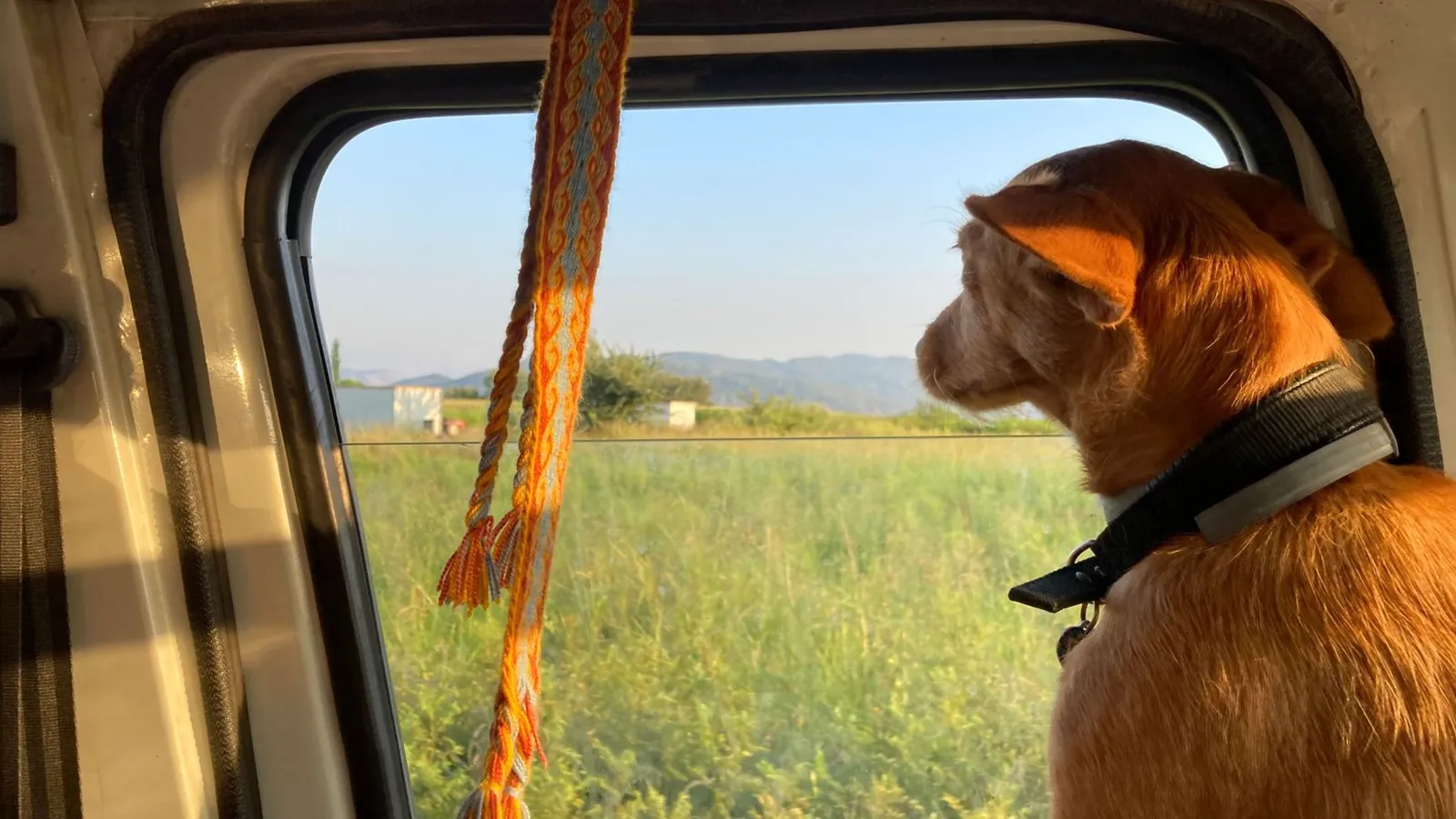
Pet areas at rest areas are common in some states and rare or undocumented in others. Where a state builds them, they are usually a marked strip of grass for dog walking, sometimes a fenced area where pets may go off leash. Everywhere else, the basics are the same: keep your dog leashed, keep it out of the buildings unless it is a service animal, pick up after it, and never leave it in a parked car in warm weather.
Our directory documents a pet area at 208 of its 1,366 public rest areas, welcome centers and service plazas. That number says more about which states publish pet data than about where dogs are welcome, as the breakdown below shows.
Where our directory documents pet areas at rest areas
A location counts in our data only when a source says it has a pet area. These are the states with documented pet areas:
| State | Locations with a documented pet area | Locations in our directory |
|---|---|---|
| California | 86 | 91 |
| Michigan | 56 | 78 |
| Iowa | 38 | 38 |
| Washington | 6 | 46 |
| Minnesota | 5 | 48 |
| Montana | 4 | 46 |
| Oregon | 3 | 17 |
| Oklahoma | 2 | 22 |
| Connecticut, Delaware, Florida, New York, North Carolina, North Dakota, Utah, West Virginia | 1 each | — |
Three states account for 180 of the 208, and in all three the state DOT publishes pet area information. Caltrans includes a PET_AREA attribute in its rest area GIS layer. Iowa DOT site pages list a “pet exercise area”, as on the Underwood I-80 eastbound page. Our Michigan data comes from MDOT’s public rest area GIS service.
Unknown does not mean no. In Texas, Ohio or Illinois, for example, our data documents no pet areas, but that only means our sources do not report them. Many rest areas there may have a grassy walking area that simply is not recorded. Look for the “pet area” sign when you arrive. If you know of one we are missing, tell us.
On I-5 in California, locations with a documented pet area include the John “Chuck” Erreca Rest Area northbound and southbound, Maxwell, Willows and Tejon Pass southbound. To find one on your own route, use the rest area finder or browse rest areas by state.
Leash rules at rest areas
Most state rules we checked require a leash or other restraint outside your vehicle. Off-leash running is allowed only in designated fenced areas, where they exist.
- California: All animals must be on a leash; an animal not on a leash must be controlled by an enclosure or other adequate restraint.
- Florida: Animals must be kept on a leash or in a cage or other restraint, except in designated fenced no-leash exercise areas, if available.
- Ohio: Household pets must be leashed at all times within the rest area.
- Pennsylvania: Leashed animals are permitted only in areas designated as pet areas, and pets may be off leash in designated fenced areas.
Pennsylvania’s rule stands out: outside the pet area, even a leashed dog is not permitted. Where your state’s rule is not listed here, follow the posted signs and keep the leash on.
Can dogs go inside rest area buildings?
Pets generally stay outside. Florida bars animals other than service animals from shelters and other buildings. Kentucky says animals shall not be allowed within buildings at its safety rest areas. Alabama states that pets are prohibited in facilities, except for service animals.
Service animals are a different category. Under the ADA, a service animal is a dog individually trained to do work or perform tasks for a person with a disability. Dogs whose only function is comfort or emotional support do not qualify. Service animals must be harnessed, leashed or tethered unless the handler’s disability prevents it.
Never leave a dog in a parked car
A rest area stop feels short, but a parked car heats up fast. The American Veterinary Medical Association says the interior temperature can rise almost 20°F in 10 minutes and almost 30°F in 20 minutes. Its chart, credited to Jan Null of San Francisco State University, shows a car reaching about 89°F after 10 minutes and 104°F after 30 minutes when it is 70°F outside. Cracking the windows makes no real difference.
The National Weather Service gives similar numbers. Its St. Louis office says a vehicle reaches 100°F in 25 minutes when it is 73°F outside, with most of the rise in the first 15 to 30 minutes. The NWS Little Rock office notes that pets are in particular danger because many have a thick coat of fur.
This matters at rest areas because the restroom stop is exactly when people leave a dog “just for a minute”. On a mild day, plan to take turns: one person walks the dog while the other goes inside. Traveling alone, a dog that cannot come in is a reason to choose a stop with a pet area close to the parking, or to keep stops in warm weather very short. In desert stretches such as I-10 near Wiley’s Well Rest Area, which has a documented pet area, summer heat makes every stop with a dog a short one.
Tips for long drives with a dog
These tips combine the AVMA’s travel guidance with our editorial advice for rest area stops.
- Restrain your dog in the car. The AVMA recommends a secure harness or a carrier.
- Keep its head inside. The AVMA warns against letting a dog hang out of a window, because of debris and the risk of falling out. It also advises against carrying dogs loose in a pickup bed.
- Leash up before you open the door. A rest area sits next to a highway ramp, and a dog that jumps out unleashed is next to fast traffic.
- Plan stops around documented pet areas where our data has them, and around rest area spacing where it does not. Our guide on how far apart rest areas are shows typical gaps by state.
- Carry water and a bowl. Our data documents drinking water at 410 of 1,366 locations. Many others may have it, but you cannot count on it from our listings alone.
- Bring bags and use the bins. Pick up after your dog in the pet area as well as on the lawns. Florida’s and Pennsylvania’s rules both require trash to go into the containers or places provided.
- Pack your dog’s records, including its rabies vaccination certificate, in case you need a vet or a kennel on the trip.
If you are traveling by RV and plan overnight stops with a dog, the stay limits in can you sleep at a rest area? and the options in free overnight parking apply to you too.
Frequently asked questions
Are off-leash dog areas common at rest areas?
They are less common than leash areas. Florida and Pennsylvania both allow off-leash pets only in designated fenced areas, and Florida’s rule adds “if available”. Our directory does not separate fenced from unfenced pet areas, so check the site when you arrive.
Can an emotional support dog go into the rest area building?
Not on the basis of the ADA. The ADA covers service animals trained to perform tasks, not animals whose sole function is emotional support. In states that keep pets out of buildings, such as Florida, Kentucky and Alabama, an emotional support dog stays outside.
Sources
- Pets in vehicles, American Veterinary Medical Association
- Excessive heat and automobiles, National Weather Service, St. Louis
- ADA requirements: Service animals, US Department of Justice, Civil Rights Division
- 21 CCR 2205 Rest area and vista point use rules, California Code of Regulations, via Cornell LII
- Fla. Admin. Code 14-28.002 Rest areas and welcome centers, Florida Administrative Code, via Cornell LII