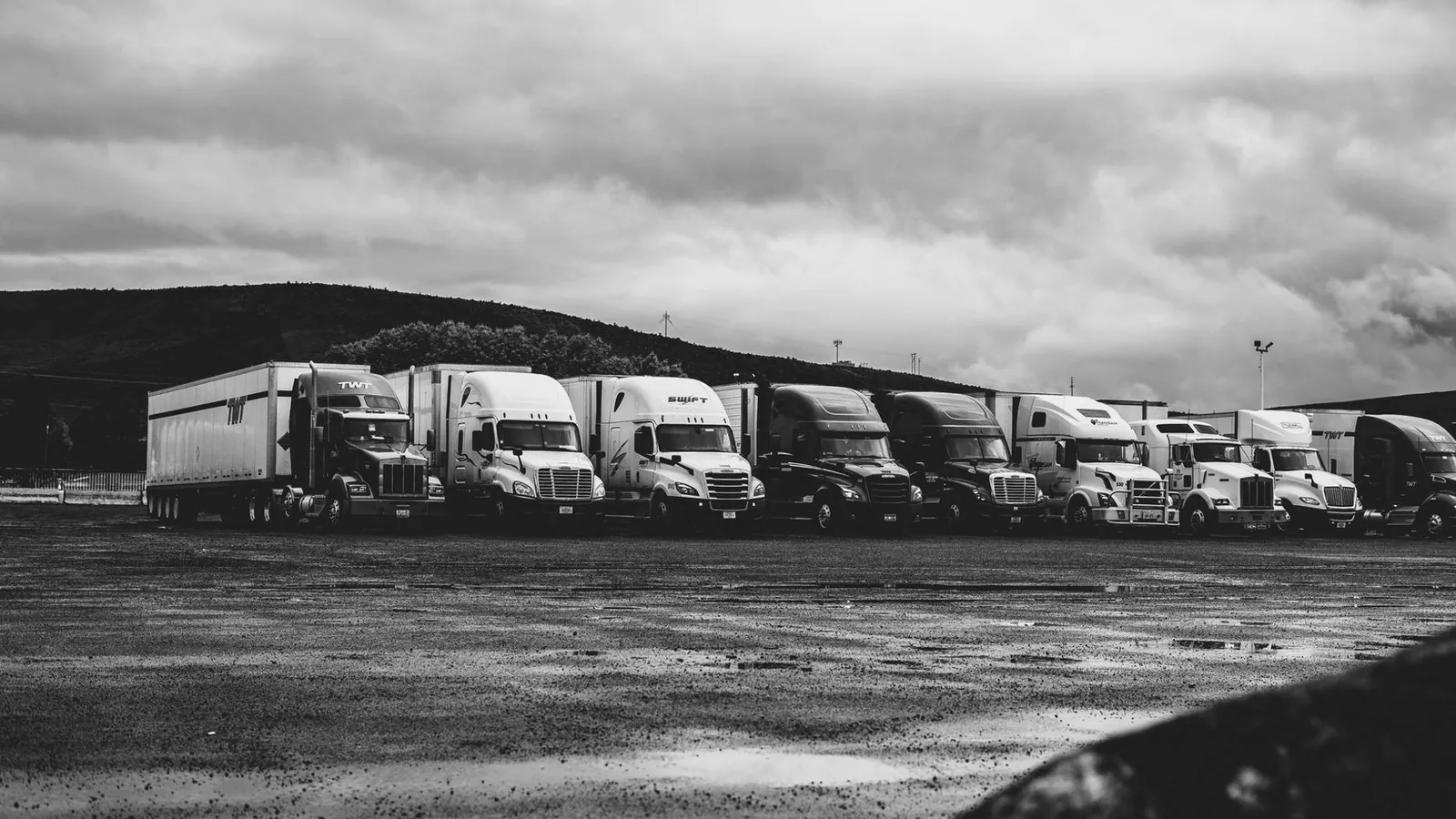
The short answer to rest area vs truck stop: a rest area is a free public stop run by the state, with restrooms and parking but, on interstates, no fuel or restaurants. A truck stop is a private business at an exit that sells fuel, food and usually showers, and sets its own parking rules. Federal law is the reason for the split. It bars service stations and other commercial businesses on interstate rights-of-way, so the gas and the burgers end up just off the highway instead.
That two-way split leaves out the stops in between. Welcome centers, toll road service plazas, weigh stations and scenic turnouts each work differently. The table below compares all six, and the sections after it explain the rules behind each row.
Six kinds of highway stops compared
| Public rest area | Welcome center | Service plaza (toll road) | Truck stop / travel center | Weigh station | Scenic turnout | |
|---|---|---|---|---|---|---|
| Who runs it | State DOT | State DOT (who staffs the info desk varies) | Toll road authority | Private company | State enforcement agency (in California, the Highway Patrol) | Road authority |
| Where | On the highway, ramps off the main lanes | On the highway, often near a state line | On the toll road itself | At or near an exit | On the highway | Beside the road at a viewpoint |
| Fuel and food | No fuel; vending machines allowed | No fuel; vending machines allowed | Yes, on many toll roads | Yes | No | No |
| Showers | Not typical | Not typical | Some plazas (all 14 on the Ohio Turnpike, free) | Commonly offered | No | No |
| Truck parking | Most in our directory (1,209 of 1,366 stops report truck spaces) | Varies | Often; Ohio Turnpike plazas list commercial spaces | Large lots are common | For inspections, not for rest | Usually not designed for it |
| Time limits | Set by each state: from 2 hours to 24 hours, or no fixed limit | Usually the state’s rest area rules (e.g., Florida, Tennessee) | Set by the toll authority | Set by the business | Not a place to park and rest | Posted signs apply |
| Cost to use | Free (vending and phone excepted) | Free | Tolls to reach it; purchases | Purchases; terms vary by business | Not applicable | Usually free |
| In our directory? | Yes | Yes | Yes | No | No | No |
Two notes on the table. “Not typical” for showers at rest areas means we found no general source saying rest areas provide them; individual sites can differ. And the time limits come from the 24 states where we verified an official rule; elsewhere, posted signs decide.
Why interstate rest areas don’t sell gas or food
Federal law keeps commerce off the interstate itself. Under 23 U.S.C. 111(a), states agree that they “will not permit automotive service stations or other commercial establishments for serving motor vehicle users to be constructed or located on the rights-of-way of the Interstate System.”
The FHWA regulation for rest areas, 23 CFR 752.5, says the same thing more bluntly. “The dispensing by any means, of petroleum products or motor vehicle replacement parts shall not be allowed,” and no charge may be made for goods and services at safety rest areas, except for telephones and vending machine items.
The law has four exceptions worth knowing:
- Vending machines. States may put vending machines in rest areas. They must give priority to machines operated through the state licensing agency under the Randolph-Sheppard Act, the federal program for blind vendors (23 U.S.C. 111(c)).
- Limited sales inside the building. Since a 2012 amendment, states may allow a short list of commercial activities for rest area customers: advertising and media displays inside the building that can’t be read from the highway, tourism books and DVDs, tickets for historical or tourism-related attractions in the state, travel information such as maps and hotel coupon booklets, and lottery machines (23 U.S.C. 111(b)). A private party may run these, but the revenue has to go back into the state’s rest areas.
- Pre-1960 facilities. The law does not require removing an establishment that existed before January 1, 1960, is owned by a state and is operated through concessionaires, provided its access meets interstate standards (23 U.S.C. 111(a)).
- Toll roads. The Federal-Aid Highway Act of 1956 allowed toll roads to be approved as part of the Interstate System, and FHWA counts about 2,900 miles of turnpikes in the system (FHWA, “Ask the Rambler”). Many service plazas on these roads sell fuel and food. Which legal basis applies differs from road to road, so we don’t generalize beyond that.
The practical result: on a free interstate, a rest area gives you a restroom, a parking space and maybe a vending machine. For fuel, you leave the highway.
Public rest areas
A safety rest area is defined in federal rules as “a roadside facility safely removed from the traveled way with parking” and facilities for motorists’ “rest, relaxation, comfort and information needs” (23 CFR 752.3). States build, run and close them.
What you’ll find varies. Across the 1,366 locations in our directory, sources document restrooms at 999, picnic areas at 507, drinking water at 410, a pet area at 208 and an RV dump station at 99. A missing entry means no source confirmed it, not that the amenity is absent.
Time limits are state law, and they range widely. Among the states where we verified an official rule, Pennsylvania allows 2 hours in 24 and Tennessee 2 hours with no overnight parking; Illinois allows 3 hours; California and Washington 8 hours in 24; Texas, Kansas and Wisconsin up to 24 hours. Several states give truck drivers longer: Florida, Minnesota and South Dakota allow 10 hours for drivers subject to federal hours-of-service rules. The full list is in our time limits by state table, and can you sleep at a rest area? covers overnight rules.
Browse by state on the rest areas by state page, or use the finder for the nearest one.
Welcome centers
A welcome center is a rest area with a travel information desk. Federal rules call them information centers: “facilities located at safety rest areas which provide information of interest to the traveling public” (23 CFR 752.3). Restroom and parking rules follow the state’s rest area rules. In Florida, for example, welcome centers and interstate rest areas are open 24 hours, while tourist information desks at welcome centers are staffed from 8:00 a.m. to 5:00 p.m. (FDOT).
Our directory lists 107 welcome centers; see welcome centers by state.
Service plazas on toll roads
A service plaza combines what a rest area and a truck stop offer, on the toll road itself. The Ohio Turnpike is a good example. Its 14 service plazas are open 24 hours every day of the year, with fuel, food and EV charging. Each plaza’s truckers lounge has “free 24-hours access to 4 private shower suites” and coin laundry (Ohio Turnpike truckers lounge).
Rules come from the toll authority, not the state rest area code. The Ohio Turnpike, for instance, requires travelers to complete their trip on the turnpike within 24 hours or pay the maximum toll on exit (Ohio Turnpike overnight parking). In our verified state time-limit research, Illinois, Kansas, Maryland, New York, Ohio and Pennsylvania each have separate rules for their tollway or turnpike facilities.
Examples in our directory include the Glacier Hills Service Plaza on the Ohio Turnpike (108 reported truck spaces) and the Morton Travel Plaza on I-77 in West Virginia (104). We list 31 service plazas so far, which is not every plaza in the country. See service plazas and our guide to toll road service plazas.
Truck stops and travel centers
A truck stop is a private business, usually at an interchange, built around fuel and long-haul drivers. FHWA’s Truck Parking Development Handbook (FHWA-HOP-22-027, 2022) describes what drivers look for there: the ability “to refuel or perform maintenance on the trucks” and “to shower, eat well, and be in a safe environment.”
Because they’re private, everything is set by the operator: prices, whether parking is free, how long you can stay, and whether cars and RVs can park overnight. Check posted signs or ask inside.
Truck stops supply most of the country’s truck parking. FHWA’s 2019 Jason’s Law survey update counted approximately 313,000 truck parking spaces nationally: about 40,000 at public rest areas and about 273,000 at private truck stops (FHWA, National Coalition on Truck Parking, 2020). By our arithmetic that is roughly 13% public and 87% private. In FHWA’s earlier survey, 53% of drivers said they regularly use a commercial truck stop for rest and 20% regularly use a rest area (FHWA Jason’s Law survey, chapter 1).
Our directory does not list truck stops. It does list reported truck parking at public stops: 25,351 spaces at 1,209 locations, mostly from FHWA/BTS data and state DOT counts. That is reported capacity, not live availability. See truck rest stops and truck parking at rest areas.
Interstate Oasis: a truck stop with an official sign
Some private businesses near interchanges carry a blue “Interstate Oasis” sign. Under FHWA’s 2006 policy, a state that takes part can designate a facility normally within 3 miles of an interchange (up to 15 miles in sparsely developed rural areas). The facility must have restrooms and drinking water open 24 hours a day, 365 days a year, free of charge, free parking for cars and heavy trucks for up to 10 hours or more, fuel, and food. FHWA states that oases “are not intended to replace public rest areas” (Federal Register, October 18, 2006). Participation is optional, so not every state uses the program.
Weigh stations and scenic turnouts
Neither is a rest stop, and our directory doesn’t list them.
Weigh stations are enforcement sites. In California, for example, they are the places “where the California Highway Patrol (CHP) inspects the weight of trucks and commercial vehicles” (Caltrans). On the Interstate System, the federal gross weight limit is 80,000 pounds, including enforcement tolerances (23 U.S.C. 127). Drivers stop there because the law requires it, not to rest.
Scenic turnouts, which federal rules call scenic overlooks, are parking areas meant “to provide the motorist with a safe opportunity to stop and enjoy a view” (23 CFR 752.3). Facilities range from a paved pull-off to a small lot with signs. Don’t count on restrooms.
Which stop should you choose?
Pick by what you need in the next 30 minutes:
- A restroom and a quick stretch: a public rest area or welcome center. It’s free, it’s on the highway, and you don’t need to find your way back to the ramp.
- Fuel, a meal or a shower: a truck stop at an exit, or a service plaza if you’re on a toll road.
- A long rest in a truck: check the state’s rest area limit first. Federal hours-of-service rules require a 30-minute break after 8 hours of driving and 10 consecutive hours off duty before an 11-hour driving window (49 CFR 395.3), and a 2- or 3-hour rest area limit doesn’t cover a 10-hour break. In the states that allow 10 hours or more, a rest area can work; elsewhere a truck stop or service plaza usually fits better.
- An overnight stop in a car or RV: the rules are the hardest part. See free overnight parking and is it illegal to sleep in your car?.
- Being tired right now: take the closest safe stop. NHTSA recommends a short nap in “a lighted, designated rest stop” when you feel sleepy (NHTSA). Our guide are rest areas safe? has practical tips, and how far apart are rest areas? shows how far the next one may be.
Rest area vs truck stop: common follow-up questions
Are there rest areas with gas stations?
Not on free interstates, with the narrow pre-1960 exception in federal law. You will find fuel at service plazas on many toll roads, and at private Interstate Oasis businesses in states that use that program. The 23 U.S.C. 111 ban is written for the Interstate System; on other highways, state practice varies.
Is it cheaper to use a rest area than a truck stop?
Using a rest area costs nothing: federal rules bar charges for goods and services at safety rest areas, apart from telephones and vending machines. A truck stop costs whatever you buy, and its parking terms are its own. A service plaza costs the toll to reach it.
Can EV drivers charge at rest areas?
Some can. Our directory documents EV charging at 31 locations, including service plazas such as Darien on I-95 in Connecticut and DOT rest areas such as Gee Creek on I-5 in Washington. See EV charging at rest areas.
Sources
- 23 U.S.C. § 111 – Agreements relating to use of and access to rights-of-way – Interstate System — Legal Information Institute, Cornell Law School
- 23 CFR § 752.5 – Safety rest areas — Legal Information Institute, Cornell Law School
- Jason’s Law Truck Parking Survey Results and Comparative Analysis, Chapter 1 — Federal Highway Administration
- Interstate Oasis Program, final policy (71 FR 61531, October 18, 2006) — Federal Highway Administration, via the Federal Register
- Commercial Vehicle Enforcement Facility (CVEF) — California Department of Transportation