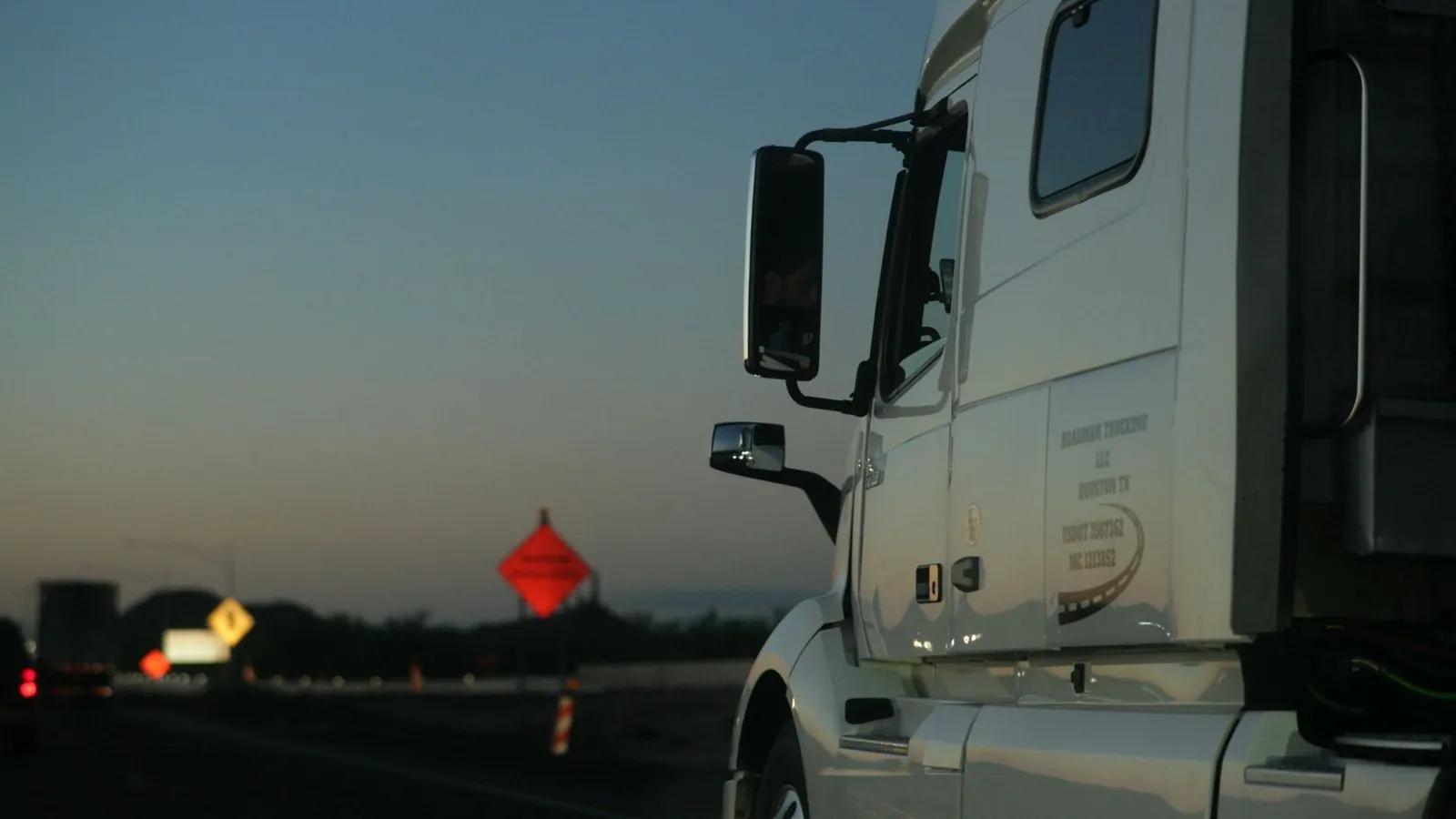
Truck parking at rest areas is public and scarce. Our directory lists 25,351 reported truck spaces at 1,209 public rest areas, welcome centers and service plazas, and the typical lot has about 16 of them. Whether a 10-hour break is even legal at a rest area depends on the state: some allow it, others cap every stay at 2, 3 or 4 hours.
These figures are reported capacity, mostly from the FHWA Jason’s Law truck parking survey published in the Bureau of Transportation Statistics’ National Transportation Atlas Database (NTAD), with state DOT counts where we have them. Capacity is not availability. A 100-space lot can be full at 9 p.m., and no figure on this page tells you how many spaces are open right now.
How much truck parking do rest areas have?
Public rest areas hold a small share of the nation’s truck parking. FHWA’s 2019 Jason’s Law survey update counted about 313,000 truck parking spaces nationally: about 40,000 at public rest areas and 273,000 at private truck stops. Ninety-eight percent of drivers in the survey reported problems finding safe parking.
Our directory covers 46 states and counts reported spaces per listing:
- 25,351 truck spaces at 1,209 locations with a reported count
- 16 spaces at the median location
- 227 locations with fewer than 10 truck spaces
- 76 locations with 50 or more
Which states have the most rest area truck parking?
Ohio reports the most truck spaces in our directory, but among these 15 states Indiana has the biggest lots on average. The 15 states below hold 63% of all reported spaces.
| State | Reported truck spaces | Locations | Average per location |
|---|---|---|---|
| Ohio | 1,611 | 83 | 19 |
| Indiana | 1,546 | 27 | 57 |
| Illinois | 1,489 | 60 | 25 |
| New York | 1,218 | 55 | 22 |
| Missouri | 1,174 | 46 | 26 |
| Texas | 1,165 | 61 | 19 |
| California | 1,133 | 73 | 16 |
| Michigan | 1,095 | 52 | 21 |
| Georgia | 983 | 25 | 39 |
| Florida | 916 | 27 | 34 |
| South Carolina | 822 | 34 | 24 |
| Kentucky | 754 | 21 | 36 |
| Virginia | 727 | 35 | 21 |
| Alabama | 709 | 28 | 25 |
| North Carolina | 691 | 43 | 16 |
Averages are rounded. A state with many small lots, such as California, can have plenty of locations and still leave you hunting for a space.
The largest truck lots in our directory
| Reported spaces | Location | Route, state |
|---|---|---|
| 201 | Greenfield Rest Area, eastbound | I-70, Indiana |
| 164 | Vince Lombardi Rest Area | I-95 (NJ Turnpike), New Jersey |
| 160 | Centerville Welcome Center, westbound | I-70, Indiana |
| 150 | Pipe Creek Rest Area, southbound | I-69, Indiana |
| 135 | Hart County Rest Area, southbound | I-65, Kentucky |
| 135 | Hart County Rest Area, northbound | I-65, Kentucky |
| 108 | Ohio Turnpike Glacier Hills Service Plaza | I-76, Ohio |
| 104 | Morton Travel Plaza | I-77, West Virginia |
| 101 | Ohio Turnpike Mahoning Valley Service Plaza | I-76, Ohio |
| 101 | Greenfield Rest Area, westbound | I-70, Indiana |
The two Ohio Turnpike figures match the Ohio Turnpike’s own list of commercial parking spaces per plaza, which puts 108 at Glacier Hills and 101 at Mahoning Valley.
Hours-of-service rules that decide where you stop
Federal hours-of-service rules for property-carrying drivers set the length of the stop you need. The rules are in 49 CFR 395.3, and FMCSA summarizes them like this:
| Rule | What it requires |
|---|---|
| 10 hours off duty | A driver may not drive without first taking 10 consecutive hours off duty. |
| 14-hour window | No driving after the 14th consecutive hour after coming on duty; off-duty time does not extend the window. |
| 11-hour driving limit | Up to 11 hours of driving within the 14-hour window. |
| 30-minute break | Required after 8 cumulative hours of driving without a 30-minute interruption. |
| 60/70-hour limit | No driving after 60 hours on duty in 7 days or 70 hours in 8 days, depending on the carrier’s schedule. |
| Sleeper berth split | The 10 hours may be split: one period of at least 7 consecutive hours in the berth plus one of at least 2 hours. |
Two kinds of stops follow from these rules. The 30-minute break fits almost any rest area. The 10-hour reset needs a place where a stay of 10 hours is allowed, and many states’ rest area rules do not allow it.
State time limits: where a 10-hour break is allowed
Of the 24 states in the table below, a 10-hour break fits within the official rest area limit in 14. In others, the limit is shorter than the federal off-duty period, so the rest area is a place for a break, not for the night. Posted signs at each site still apply, and toll road service plazas set their own rules.
| State | Official limit at state rest areas | Room for a 10-hour break? |
|---|---|---|
| Florida | Trucks 10 h (commercial drivers under hours-of-service); others 3 h | Yes, exactly 10 h |
| Idaho | 10 consecutive hours at interstate rest areas | Yes, exactly 10 h |
| Minnesota | Trucks 10 h at rest areas with truck stalls; others 4 h | Yes, exactly 10 h |
| New York (NYSDOT) | Commercial vehicles up to 10 h while the driver takes required rest | Yes, exactly 10 h |
| South Dakota | 10 consecutive hours for drivers under federal hours-of-service; others 3 h | Yes, exactly 10 h |
| Washington | 8 h per 24 h; commercial vehicles up to 1 h beyond their federally required rest | Yes |
| Montana | 12 h | Yes |
| Oregon | 12 h per 24 h | Yes |
| Nevada | 18 h total in any two weeks | Yes, once per two weeks |
| Kansas | 24 h; trucks must use truck parking | Yes |
| New Mexico | 24 h within any three days | Yes |
| Texas | 24 h | Yes |
| Wisconsin | 24 h or the posted limit, whichever is shorter | Yes, unless posted shorter |
| Utah | No hour limit; no overnight camping | Yes |
| California | 8 h per 24 h, trucks included | No |
| Kentucky | 4 h per 24 h without a permit | No |
| Illinois | 3 h | No |
| Maryland | 3 h; no overnight parking | No |
| Ohio | 3 h unattended | Depends on the site; Turnpike plazas have their own rules |
| Pennsylvania | 2 h per 24 h or the posted limit | No |
| Tennessee | 2 h; no overnight parking | No |
| Virginia | No overnight parking; posted limits apply | No |
| Alaska | Posted limit at each site | Check the sign |
| Massachusetts | Posted limit at each site | Check the sign |
The full rule text and sources for each state are in our truck rest stop time limits table. For the difference between parking, sleeping and camping, see can you sleep at a rest area.
What Jason’s Law is and what it changed
Jason’s Law is Section 1401(c) of the 2012 federal transportation law MAP-21. It is named for truck driver Jason Rivenburg. In March 2009, unable to find a safe place to rest near his South Carolina delivery, he parked overnight at an abandoned gas station, where he was attacked and murdered, according to FHWA.
The law does not require any rest area to add spaces. It directed USDOT to survey each state’s capability to provide truck parking, assess truck traffic volumes and develop metrics for parking adequacy (FHWA, 2015 survey report). The first survey, published in August 2015, found shortages in most states. They were worst along major corridors and freight hubs such as the Chicago area, the I-95 corridor, the New York City area and the I-5 corridor.
The survey data is the base of most rest area truck counts, including ours. The NTAD Truck Stop Parking dataset on Data.gov was compiled in April 2019. FHWA and FMCSA also publish a joint memorandum on using federal funds for truck parking, updated in June 2025.
How to find truck parking at a rest area
Plan the stop before the clock forces it. In FHWA’s 2015 survey, 90% of drivers said they struggle to find safe, available parking at night, so the steps below treat truck parking at rest areas as one option among several.
- Choose the stop by your hours, not the other way round. Work out where your 11-hour or 14-hour limit will run out, then pick a rest area before that point and a second one as backup.
- Check the state’s time limit for your break. If the state caps stays at 2 to 4 hours, use the rest area for your 30-minute break and look elsewhere for the 10-hour reset.
- Look for real-time availability where it exists. Eight Midwest states run the MAASTO Truck Parking Information Management System: Indiana, Iowa, Kansas, Kentucky, Michigan, Minnesota, Ohio and Wisconsin. Roadside “Available Truck Parking” signs show open spaces at monitored lots (Kentucky Transportation Cabinet). Only some rest areas are monitored.
- Favor big lots in the evening. The larger lots in the tables above give you better odds than a 6-space lot. Toll road plazas such as the Ohio Turnpike’s add showers and lounges; see our turnpike service plaza guide.
- Check for closures before a long gap. A closed rest area removes its whole lot for the day. Our rest area closures guide shows how to check each state’s 511 service.
- Have a private truck stop in mind. FHWA’s survey counts far more spaces at private truck stops than at public rest areas. Rest area vs. truck stop explains the trade-offs. Our directory does not list private truck stops.
Use the rest area finder or browse truck rest stops by state to see the reported truck spaces at each location on your route.
Frequently asked questions about truck parking at rest areas
Can I take my 10-hour break at a rest area in a state that allows only a few hours?
Not legally under the state rest area rule. Hours-of-service rules require the break; they do not override a state’s parking limit. Plan the reset at a place where a long stay is allowed, and use the short-limit rest area for your 30-minute break.
Does truck parking at public rest areas cost anything?
The state rest area rules in our time-limits table set time limits, not parking fees. Toll road plazas work differently because you pay the toll to get there. The Ohio Turnpike, for example, offers overnight truck parking with free access to a truckers’ lounge and lists no parking fee. Every trip on the Turnpike must still finish within 24 hours, or the maximum toll is charged.
Why does a rest area show truck spaces in your directory but I found none open?
Our figures are reported capacity, not live counts. A survey count can also date from 2019 or earlier, and lots are rebuilt or restriped over time. Treat the number as a guide to lot size, then use a real-time system or the state’s site where one exists.
Sources
- Jason’s Law Truck Parking Survey: 2019 results (National Coalition on Truck Parking, December 1, 2020) — Federal Highway Administration
- Jason’s Law Truck Parking Survey Results and Comparative Analysis, Executive Summary (August 2015) — Federal Highway Administration
- Truck Stop Parking (NTAD dataset) — Federal Highway Administration via Data.gov
- Summary of Hours of Service Regulations — Federal Motor Carrier Safety Administration
- 49 CFR 395.3, Maximum driving time for property-carrying vehicles — Code of Federal Regulations (Legal Information Institute)
State-by-state rule texts are listed in our rest area time limits table.